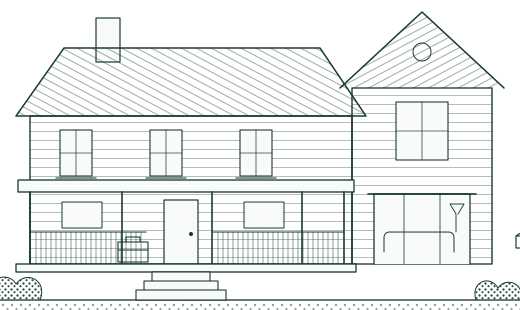
Coverage A is the house. B is the garage and the fence. The rest is where people get surprised. We go through yours with you, letter by letter, and compare it across several carriers.
Tap a letter on the drawing or below to see what it covers.More about →
[{"k":"A","label":"A · Dwelling","d":"The house and what’s built into it.","short":"A"},{"k":"B","label":"B · Other structures","d":"The detached garage, the shed, the fence.","short":"B"},{"k":"C","label":"C · Personal property","d":"Your belongings, at home or away.","short":"C"},{"k":"D","label":"D · Loss of use","d":"Extra living costs while you can’t live there.","short":"D"},{"k":"E","label":"E · Personal liability","d":"Injury or damage you cause to other people.","short":"E"},{"k":"F","label":"F · Medical payments","d":"A guest’s medical bills after a fall at your place.","short":"F"}]
Letter by letter, in plain English.
Pick a letter. The close-up shows the part of the house it covers, and the note says what it pays for, what people miss, and the question we’d ask about yours.
Not sure what your own page says? Send a photo of your declarations page and we’ll read it with you, letter by letter.
Close-up: Coverage A, DwellingDrawing, not to scale
ACoverage ADwelling
The house itself, plus what’s attached or built in: the attached garage, plumbing, wiring, the furnace and central air, built-in appliances.
Often missed
The limit should be what it costs to rebuild, not what the house would sell for. Most companies want you insured to at least 80% of replacement cost, or partial claims get paid short.
How the limit is usually set. Set from a rebuilding-cost estimate. Kansas homeowners usually carry a separate wind and hail deductible, generally 1% to 2% of this amount.
Ask us: “When was your rebuild cost last updated?”
BCoverage BOther structures
Structures that aren’t attached to the house: a detached garage, a shed, a barn-style workshop, fences, a wood deck that stands on its own.
Often missed
It covers the building, not what’s stored inside it. The tools in the shed are Coverage C.
How the limit is usually set. Often set at a share of A (10% is common). If the shop out back is worth more than that, the limit can be raised.
Ask us: “Do you have an outbuilding worth more than a tenth of the house?”
CCoverage CPersonal property
The things you own: furniture, clothes, electronics, tools. It follows you, so a laptop stolen from your car is usually a Coverage C claim.
Often missed
Many policies pay actual cash value (after wear and tear) unless you buy replacement cost. Jewelry, guns and collections have special lower limits unless you list them separately.
How the limit is usually set. Generally about half of A. Your home inventory, photos and receipts, tells you whether that’s enough.
Ask us: “Would your contents be paid at replacement cost or actual cash value?”
DCoverage DLoss of use
If a covered loss makes the house unlivable, this pays the extra cost of living somewhere else: the rental, the extra miles, restaurant meals above your normal grocery bill.
Often missed
Only the difference above your normal costs, and only when the cause is covered. Keep every hotel and meal receipt.
How the limit is usually set. Varies by carrier; some set a dollar amount, some a time period. We read yours with you.
Ask us: “How long could you be out if the kitchen burned?”
ECoverage EPersonal liability
If you’re responsible for someone else’s injury or property damage, at home or out in the world, this pays for your defense and what you owe, up to the limit.
Often missed
It doesn’t cover car accidents (that’s your auto policy), business activities, or anything done on purpose. A dead tree you knew about can be a liability question when it falls on the neighbor’s fence.
How the limit is usually set. Many policies start around $100,000. Higher limits cost more, and an umbrella sits above this one.
Ask us: “Is your liability limit close to what you own?”
FCoverage FMedical payments
Small medical bills for a guest who gets hurt at your place, paid without anyone having to prove it was your fault. Think a neighbor who slips on the porch steps.
Often missed
It never pays for you or the people who live with you; that’s your health insurance.
How the limit is usually set. Typically written at $1,000 per person, with higher amounts available.
Ask us: “Do you have regular visitors, a pool, or a trampoline?”
General descriptions of a standard homeowners policy (special form), from the Kansas Insurance Department’s Home and Renters Shopper’s Guide. Your policy’s wording and your declarations page decide the details.
Four policies. One office that reads them with you.
Every policy has its own parts, and most of them are lettered. Open one to see how it’s built.
Home
Lettered A to F
Dwelling, outbuildings, belongings, a place to stay, liability, guests’ medical bills.
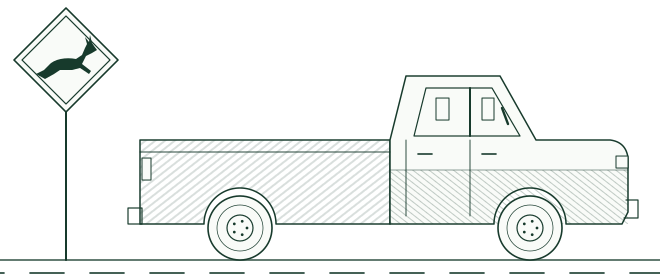
An umbrella policy adds liability coverage, usually $1 million to $5 million, above the limits on your auto and home policies. It pays only after the policy underneath has paid its full limit.
Carriers usually require certain limits underneath, and many want to write your home and auto too. We line those up so there’s no gap between the layers.
Auto pays $250,000. The umbrella pays $550,000. You pay nothing out of pocket on the judgment.
Illustrative example: a $250,000 per-person Part A limit, a $1,000,000 umbrella and an $800,000 judgment after a crash you caused. Real limits and carrier rules vary.
Something happened. Here’s what to do first.
Your insurance company pays the claim. We help you report it, read your policy with you, and stay on it until it’s settled. After hours, the claims line rings one of us.
Stock photo
1
Make it safe
People first. Shut off water at the main, or gas if you smell it, and step away from downed lines.
2
Photograph everything
Before you clean up: wide shots, close-ups, the date. Video works too.
3
Stop more damage
Tarp the roof, board the window, pull up wet carpet. Keep receipts; reasonable temporary repairs are usually reimbursed.
4
Call us or the carrier
Report it as soon as you can. Write down who you talked to, when, and what they said.
5
Keep the damaged things
Don’t throw anything out or sign a repair contract until the adjuster has seen it.
Haskett Insurance Agency
Claims help, any hour
Nights, weekends and holidays, this line forwards to whichever of us is on call.
Your carrier’s 24-hour claim line is on your ID card. Call either one first.
When you call, have:
Your policy number
When and where it happened
Your photos
Other driver’s name, plate and insurer
Your insurance company
Investigates, sends the adjuster, pays the claim. In Kansas it has 30 days to finish investigating or explain why not.
Us
Help you report it, explain what your policy says, and follow up with the adjuster until it’s settled.
Steps adapted from the Kansas Insurance Department’s claim guidance. If you can’t reach agreement with your insurer, the department’s Consumer Assistance Hotline is 1-800-432-2484.
Several carriers, compared by the letter.
A captive agent sells one company’s policies. As an independent agency we’re appointed with several, so we can put their quotes side by side.
Price is one line on the sheet. The rest is how each one pays for your roof, your belongings and a backed-up drain. We mark what differs before you choose.
Quote sheet for one house, three carriers (illustrative; carriers and terms are made up, prices left off on purpose)
Coverage
Carrier 1
Carrier 2
Carrier 3
ADwelling paid at
Replacement cost
Replacement cost
Replacement cost
AWind and hail deductible (differs)
1% of A
2% of A
1% of A
ARoof paid at (differs)
Replacement cost
Actual cash value
Replacement cost
BOther structures
10% of A
10% of A
10% of A
CBelongings paid at (differs)
Replacement cost
Replacement cost
Actual cash value
CWater backup add-on (differs)
Available
Not offered
Available
ELiability
$300,000
$300,000
$300,000
Request a quote, or a look at what you have.
Dana calls you back within one business day with questions, then lays the quotes side by side.
Have your declarations page handy
It’s the summary page of your current policy. Every letter is on it, with its limit, so we can quote like for like.
ADwelling
BOther structures
CPersonal property
DLoss of use
EPersonal liability
FMedical payments
Or stop by. North Main Street, Hutchinson. Monday to Friday, 8:30 a.m. to 5:30 p.m. Saturdays by appointment.
Who you’ll talk to
KH
Kim Haskett
Home and auto: new homes and refinances, adding a teen driver
No. Like most agencies, we’re paid a commission by the insurance company whose policy you choose. You never get a separate bill from us.
Does my homeowners policy cover a flood?
No. Every homeowners policy excludes flood and rising water. Flood coverage comes from the National Flood Insurance Program, and we can write it. There’s usually a 30-day wait before it starts, so don’t wait for the forecast.
What is a wind and hail deductible?
Most Kansas homeowners policies have a separate deductible for wind and hail, generally 1% to 2% of your Coverage A amount. On a house insured for $250,000, 1% means you pay the first $2,500 of a hail claim. Other claims use your regular dollar deductible.
Will you handle my claim?
The insurance company investigates and pays the claim. We help you report it, read your policy with you so you know what to expect, and stay on it with the adjuster until it’s settled.
My teenager just got a license. What do we do?
Call before they drive alone. If they don’t own the car, they can often be rated on your policy as an occasional driver, and assigning them to the right vehicle matters. Ask about good-student and driver-training credits too.
How often should we look at our coverage?
Once a year, and any time something changes: a remodel, a new roof, a new car, a home business, a new driver. Building costs rise, and it’s on you to keep the limits current. Our annual review takes about 30 minutes.





'%3e%3cpath%20d='M0%202.5%20H5'%20stroke='%23173a2c'%20stroke-width='0.6'%20stroke-opacity='0.65'%3e%3c/path%3e%3c/pattern%3e%3c/defs%3e%3cpath%20d='M60%20120%20Q200%20-10%20340%20120%20Q326%20106%20312%20120%20Q298%20106%20284%20120%20Q270%20106%20256%20120%20Q242%20106%20228%20120%20Q214%20106%20200%20120%20Q186%20106%20172%20120%20Q158%20106%20144%20120%20Q130%20106%20116%20120%20Q102%20106%2088%20120%20Q74%20106%2060%20120%20Z'%20fill='url(%23v4-hat)'%20stroke-width='1.5'%3e%3c/path%3e%3cpath%20d='M200%2040%20V186%20q0%2014%20-14%2014%20q-12%200%20-12%20-12%20M200%2040%20V26%20M116%20120%20Q140%2060%20200%2040%20M284%20120%20Q260%2060%20200%2040'%20stroke-width='1.3'%3e%3c/path%3e%3c/svg%3e)



 KH
KH DR
DR