Every frame is measured twice.
Once by the maker, in the numbers printed inside the arm. Once by us, on your face. This page is the first half: how to read a frame, what lens materials change, and what happens between choosing a frame and wearing it.
OP.02-AINSIDE THE ARM
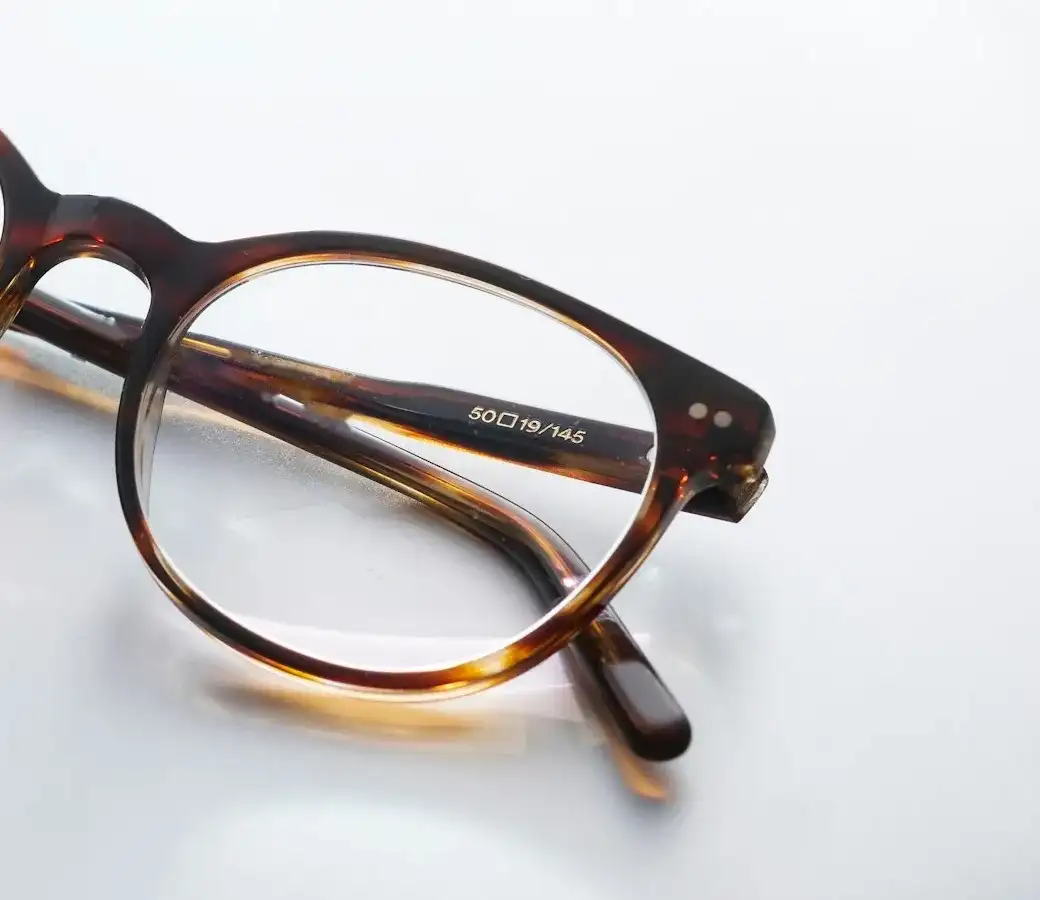
Read the inside of the arm.
Most frames carry the same five things on the inside of the arms, in roughly this order. The maker’s name and country are usually on the other arm.
OP.02-BLENS THICKNESS
Two choices make a lens thinner. Material, and eye size.
1.50Standard plastic
mm
1.60Mid-index
mm
1.67High-index
mm
1.74Highest index
mm
OP.02-CLENSES
Four kinds of lens, four coatings worth knowing.
- SVSingle vision
One prescription across the lens, for distance or for reading.
- PALProgressives
Distance at the top, reading at the bottom, with no line. We measure where your pupils sit in the frame you picked so the zones land in the right place.
- OFCComputer and office lenses
Wide middle and near zones for a desk and a screen. Many people over 45 keep a second pair for work.
- SUNPrescription sunglasses
Any frame that takes a lens, tinted or polarized. Polarized lenses cut glare off water and roads.
- Anti-reflective
Fewer reflections in the lens, for night driving and photos. We pair it with most high-index lenses.
- Scratch-resistant
A hard coat on every plastic lens we sell.
- Light-reactive
Lenses that darken outdoors. Most darken less behind a windshield.
- Impact-resistant materials
Polycarbonate or Trivex in every kid’s pair and every safety pair.
OP.02-DFROM FRAME TO FACE
From the wall to your face in four steps.
- Day 1Choose and measure
Frame, lenses, and three fitting measurements: pupil distance, fitting height, and how the frame tilts.
- Days 2–10At the lab
Lenses are surfaced to your prescription, cut to the frame’s shape and checked against the order.
- PickupFitted on you
We bend the temples and pads to your face before you leave. Twenty minutes, not two.
- AfterCome back any time
Glasses loosen. Tightening and refits are free for as long as you own them.
OP.02-EADJUSTMENTS
Loose, crooked or squeaking? Walk in.
Glasses drift out of shape: a hinge loosens, an arm gets sat on, nose pads yellow. Most fixes take a few minutes at the bench, and they’re free whether or not you bought the frame here.
Adjustments and refitsFree
Any frame, bought anywhere. Walk in.
Nose pads and screwsFree
We keep the common sizes in the drawer.
Lenses in your own frameAsk us
If the frame is sound, we’ll check it can take new lenses.
Broken hinge or armAsk us
Some we fix, some go back to the maker. We’ll tell you which on the spot.